
Non-destructive
Screen supported packages without opening them or transferring the material.
NSF-supported field product in development
iNQR / Through-package solid identification
iNQR reads phase-specific nuclear signatures from bulk solids inside supported opaque packaging. It is designed for a clear field decision while avoiding direct sample handling.
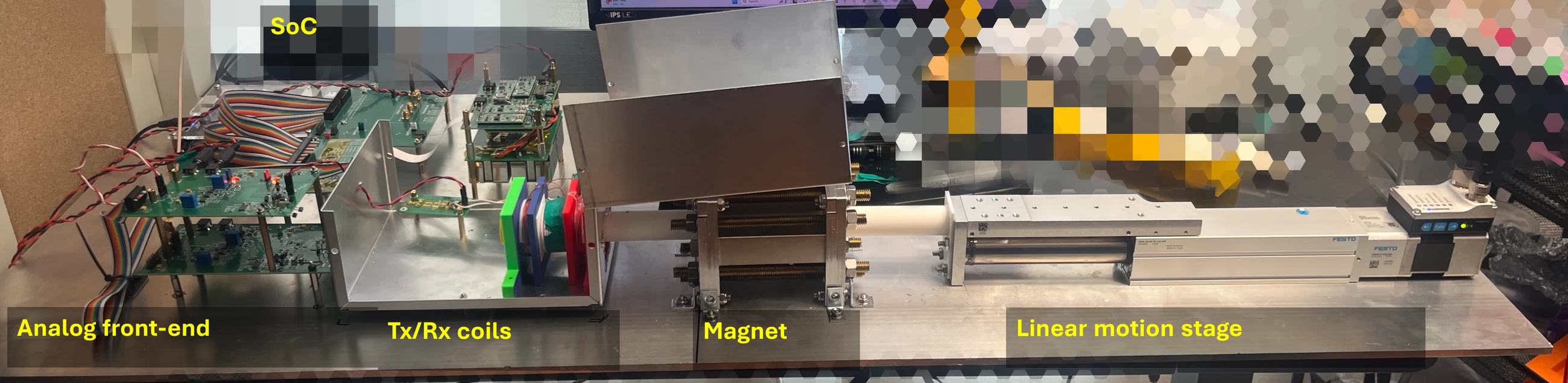
Screen supported packages without opening them or transferring the material.
Target the crystal structure itself rather than color or surface appearance.
Retain raw data and measurement context behind every field result.
Measured Phase I result
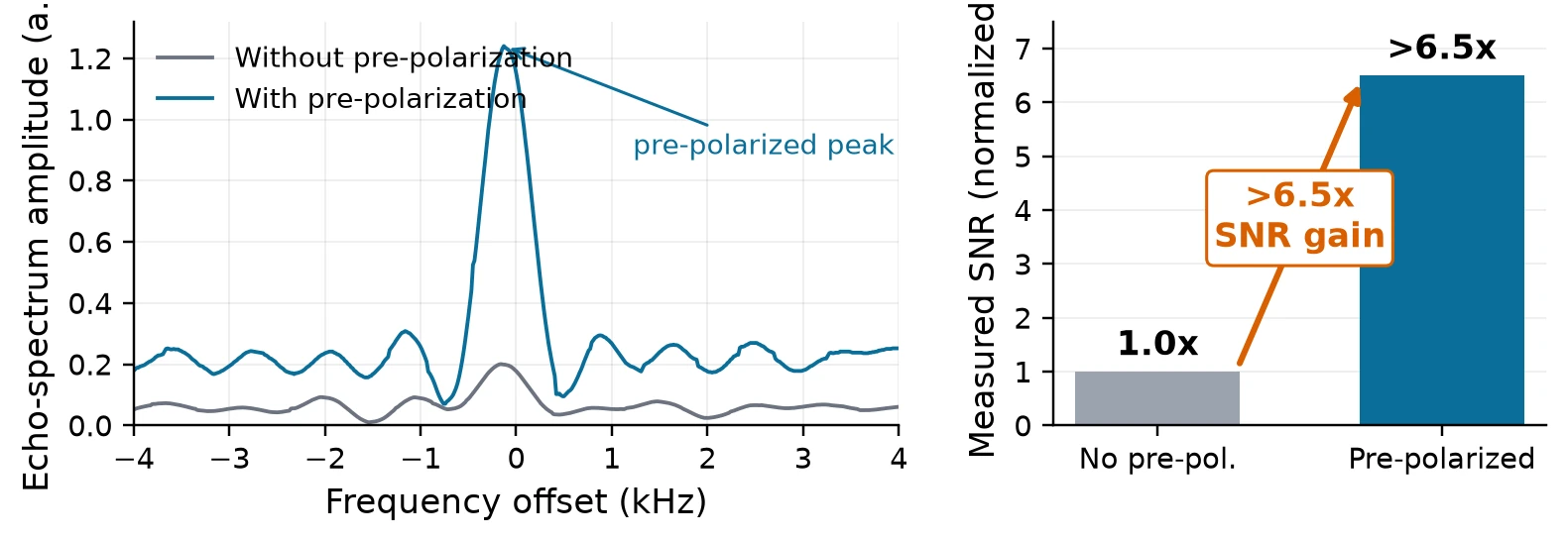
>6.5×A custom 0.65 T Halbach magnet increased the acetaminophen signal-to-noise ratio by more than 6.5×—equivalent to roughly 1/42 the averaging time at equal SNR.
Prototype + validation targets
The table separates the hardware already built and measured in Phase I from the quantitative acceptance criteria proposed for the field product. Frequency coverage, acquisition rate, recovery time, decision time, detection probability, false-positive control, temperature, and RFI performance are stated explicitly.
| Specification | Value | Basis |
|---|---|---|
| Measured nucleus / mode | Pulsed nitrogen-14 NQR; no homogeneous static measurement field | Phase I hardware |
| Implemented RF scan bands | 0.5–5 MHz using programmable Tx/Rx matching networks and tunable digital filters | Phase I hardware |
| Signal acquisition | 8 simultaneous ADC channels at up to 80 MS/s | Phase I hardware |
| Transmit / receive coils | Separate Helmholtz transmitter and solenoid receiver; gradiometer receive topology evaluated for RFI and ring-down suppression | Phase I hardware |
| Controller and interface | FPGA/ARM system-on-chip running Linux; phase-coherent pulse generation, real-time averaging, and Ethernet host control | Phase I hardware |
| Pre-polarization field | 0.65 T custom four-element Halbach dipole with stepper-driven sample transfer | Phase I hardware |
| Measured pre-polarization gain | >6.5× SNR on acetaminophen; approximately 1/42 the averaging time at equal SNR | Measured Phase I result |
| Power architecture | Autonomous operation from a single battery pack | Phase I architecture |
| Supported package materials | Paper, cardboard, and opaque non-metalized polymers | Phase II product scope |
| Excluded package materials | Conductive and metalized packages return inconclusive rather than negative | Product boundary |
| Primary challenge mass | 5 g of a validated target compound | Phase II acceptance condition |
| Operating temperature | 5–40 °C | Phase II acceptance condition |
| Decision timing | Engineering objective: tens of seconds; acceptance ceiling: 5 minutes | Phase II target |
| Detection probability | ≥95% at the 5 g primary challenge condition | Phase II acceptance condition |
| False-positive rate | ≤1% one-sided 95% upper confidence bound; at least 300 negative trials if zero false positives occur | Phase II acceptance condition |
| Transmit-to-receive recovery | ≤100 µs, or demonstrably before the earliest usable echo for each validated sequence | Phase II hardware target |
| Pre-polarization repeatability | ≥5× median SNR gain with ≤10% coefficient of variation across 3 builds or rebuilds | Phase II hardware target |
| RFI cancellation | ≥15 dB median suppression in cancellable cases without calibration-echo distortion | Phase II hardware target |
| Operator result | Logged detected / not detected / inconclusive decision with raw data, temperature, coil/tuning state, and software/library versions retained | Phase II workflow |
Designed for a bounded decision
The initial field product is aimed at screening supported packages for target bulk crystalline compounds. It complements trace detection, Raman screening, laboratory confirmation, proper evidence handling, and agency policy.
Need to identify a solid through packaging?